
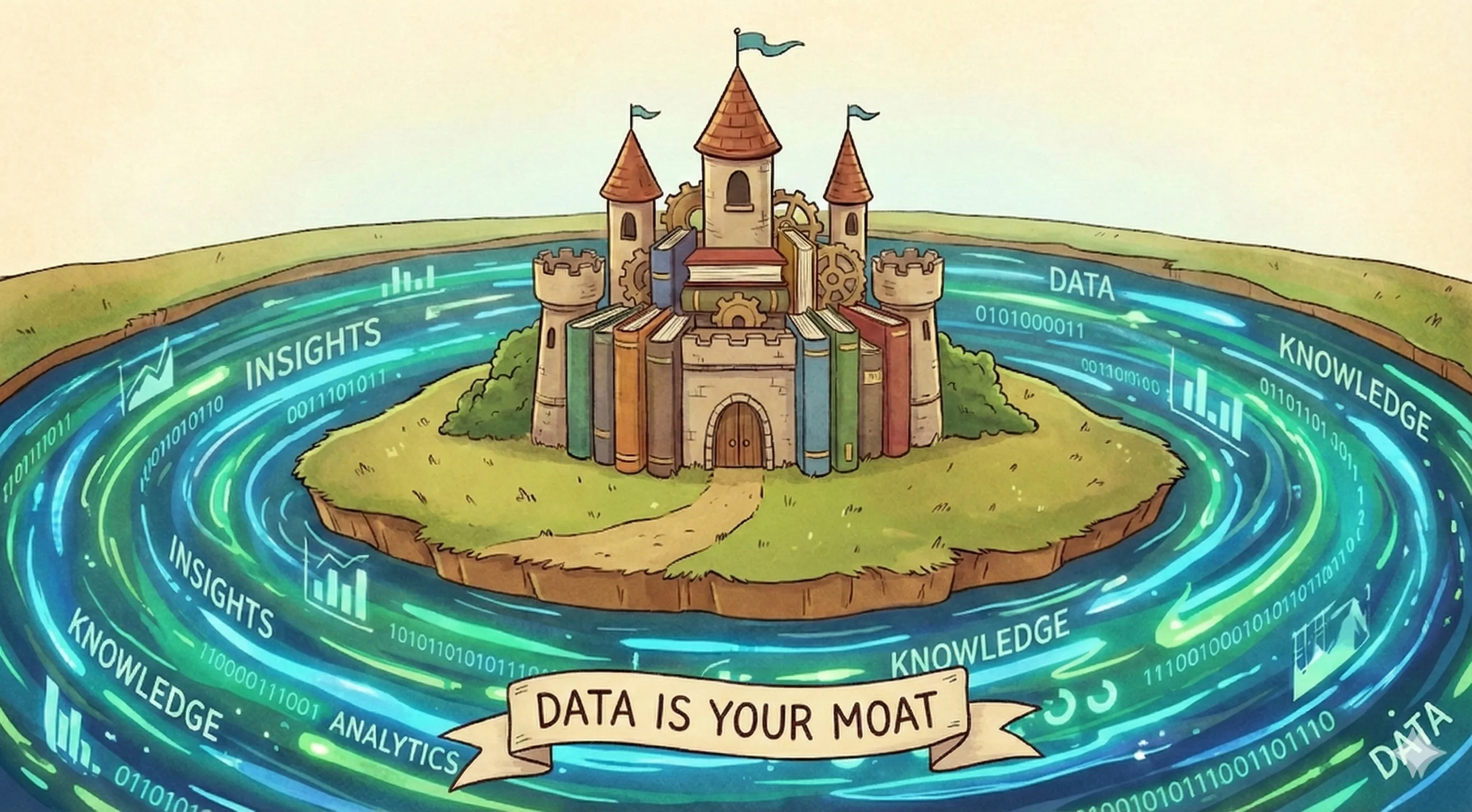
Most companies think of observability data as an operational expense. Something you collect, query during incidents, and eventually delete to keep costs manageable.
That thinking is changing fast. With LLMs for analytical tasks being commoditized, the companies that keep their operational history have a compounding advantage over others.
We're entering an era where the competitive moat is the data you feed a model. Companies with rich, granular, long-term history of their data will be able to understand their business better.
Your telemetry is business data
Engineering leaders draw a line between "business data" and "infrastructure data." Customer records, transactions, product analytics — that's business data. Logs, metrics, traces — that's ops stuff.
That line is now disappearing fast.
Take frontend observability. Real User Monitoring captures page loads, click paths, session durations, error rates by geography and device type, rage clicks, drop-off points in checkout flows. Teams file this under "observability" because the tooling sits in the monitoring stack. But this data has end user behavior. Where people get stuck. Where they leave. What breaks their experience. Strip away the engineering labels and you're looking at product analytics and customer research — generated passively, at full resolution, for every single user session.
Product managers pay separately for tools like Pendo and Amplitude to answer questions that are already sitting in telemetry data. They just can't get to it because it's locked inside an engineering tool with an engineering query language.
Now look at AI agent telemetry. Every agent call generates a trace: which model was invoked, how many tokens were consumed, what latency the user experienced, whether the output was used or discarded, what tools were called, what the total cost of that interaction was. String a few months of this together and you have a complete timeline of cost versus outcome for your entire AI investment. Which agents are worth what they cost. Which workflows burn tokens without producing results. Where model spend is actually translating into user value and where it's just running up a bill.
No finance dashboard gives you this. No product analytics tool captures it. It lives in your telemetry.
And then there's the infrastructure layer underneath — how your systems behave under load, which services degrade first during traffic spikes, how deployment patterns correlate with customer-facing errors, where latency hides before it becomes an outage.
Every layer of your stack is generating business intelligence. Infrastructure telemetry tells you about operational risk and capacity. Frontend telemetry tells you about customer experience. AI telemetry tells you about the ROI of your most expensive new investment. The companies that treat all of this as disposable ops data are sitting on answers they're paying other tools to approximate.
The retention trap
Today the observability platforms make it economically irrational to keep your data long enough for it to become valuable.
Volume-based pricing means storage costs grow linearly with retention. So teams take the rational approach: they cut retention, drop granularity, downsample.
So essentially, the vendor's pricing model is making the decision for you: your operational history isn't worth keeping.
And once it's gone, it's gone. You can't reconstruct the telemetry from a Tuesday night six months ago when your checkout service started throwing intermittent errors that turned into last week's outage.
The companies that figured this out
While the data is more valuable than ever, the pattern is quite old. The organizations that treat historical telemetry as a strategic asset, keep showing up on the right side of these stories.
Let's look at a few examples.
When the SolarWinds breach was discovered in December 2020, the forensic investigation required tracing attacker activity back to October 2019 — over fourteen months of historical firewall logs, access control logs, and SIEM events. One of the top recommendations that emerged from the incident: review your log retention policies. The data you deleted last quarter might be the data you need tomorrow.
Uber built its entire Data Quality Monitor around the principle that you need deep historical baselines to detect anomalies. Their engineering team found that meaningful pattern detection — catching state-shifts, seasonal drift, schema changes — requires a minimum of two months of continuous history, and gets materially better with more. They use that historical data to automatically flag when today's data deviates from established patterns, catching pipeline failures and data corruption that would otherwise go unnoticed until a downstream team files a bug report.
Netflix invested in building a tiered telemetry architecture — Elasticsearch for recent data, Hive for longer-term storage — specifically because their teams kept running into the same wall: they needed historical data to distinguish genuine anomalies from normal seasonal variation. Their anomaly detection compares current metrics against historical baselines. Without that history, every spike looks like an emergency and every dip looks like a problem. With it, the system can tell the difference between a real issue and a busy Friday night.
And then there's the security dimension. In September 2025, CISA responded to a federal agency breach where attackers had roamed the network undetected for three weeks. The telemetry data existed — EDR tools had generated alerts — but nobody reviewed them in time, and retention policies meant the earliest indicators were already aging out. The post-incident analysis was blunt: every step of the attack likely generated telemetry. The data was there. It just wasn't kept long enough or made accessible enough to matter.
A 2022 industry survey found that 94% of observability practitioners said longer-term data retention was important to their work, with 70% calling it very important. The gap between what teams want to keep and what their platforms make economically viable is where institutional knowledge goes to die.
The ownership problem
Even what you do manage to retain, most observability platforms store your data in proprietary formats on infrastructure you don't control.
You can query it through their interface. You can export fragments of it through their API. But you can't run your own models against it. You can't move it. You can't query it with tools the vendor doesn't support.
When your operational history lives inside a vendor's proprietary system, your moat belongs to them. They decide what you can ask, how long you can keep it, and what it costs to access.
Switching vendors means starting your retention clock from zero. Every pattern, every baseline, every historical comparison — gone. This is why switching costs in observability feel so high even when the financial cost of switching is manageable. You're not just changing tools. You're abandoning years of institutional knowledge.
So the picture is this: you're forced to delete most of your data because keeping it is too expensive, and the fraction you do keep is locked in a format you can't use independently. Your most valuable operational asset is being simultaneously destroyed and held hostage.
Why this matters now
Over the past year, model layer is commoditizing fast. And the agentic use cases are evolving fast. It is clear that agents will do majority of work.
Llama, Mistral, Qwen, Gemma, DeepSeek — capable open weight models are everywhere now, and they're getting better every quarter. Combined with LLM Cloud offerings, the barrier to running a powerful model internally has dropped significantly.
This changes the competitive equation entirely. When everyone has access to roughly equivalent models, the differentiator is what you feed your model. Every company will soon be able to run models against their own data for anomaly detection, incident pattern recognition, capacity forecasting, cost optimization.
The models are table stakes. The question is: do you have the data to make them useful?
A team with 12 months of telemetry at full granularity can train anomaly detection on their own baselines — not generic thresholds from a vendor. They can build incident pattern recognition that understands their specific failure modes across seasons and traffic cycles. They can forecast capacity based on actual growth curves from their own infrastructure, not industry benchmarks that may have nothing to do with their architecture.
A team running on 30-day retention can't do any of this. They don't have enough history for a model to learn from. They're stuck relying on their vendor's generic AI features — built on aggregated data from other companies, tuned for average behavior, blind to the specific patterns that matter in their environment.
The irony is sharp. The companies paying the most for observability are often retaining the least data — and in a format they can't run their own models against even if they wanted to.
This is the moat. Your data — complete, granular, in an open format, under your control — is the one thing a competitor can't replicate.
What changes when storage economics change
The reason teams can't keep their data has never been technical. It's economic. Indexing at ingest is expensive. Proprietary storage formats can't be compressed efficiently. And the pricing model is built around volume, so retention becomes a cost lever rather than a strategic choice.
Change the storage economics and the whole calculation shifts.
At Parseable, we store telemetry in open Parquet format on S3-compatible object storage. Columnar compression at up to 90% means the same data that costs you a dollar to store elsewhere costs you pennies with us. Not because we negotiate better cloud rates, but because the format and architecture are fundamentally more efficient.
What does that mean in practice? A team currently retaining 30 days of logs on a traditional platform could retain 6-12 months on Parseable for less than what they're paying today.
More data. Longer retention. Lower cost. Because the underlying architecture is that much more efficient.
And because it's open Parquet on S3 you control, that data is genuinely yours. Query it with Parseable. Query it with Spark, DuckDB, Athena, or anything else that reads Parquet. Run your own models against it. Move it wherever you want. The format doesn't care which tool you use, and neither do we.
Parseable Cloud offers this architecture as a fully managed service. We offer up to 12 months of retention included in our Pro plan at 0.39 cents per GB ingested. On Enterprise plans you can bring your own bucket and take this to unlimited retention at the same cost. We also offer a self-hosted version that you can run on your own infrastructure, with no limits on retention or volume.
The compounding advantage
Here's where this gets interesting over time.
Month one, you have the same visibility as anyone else. Month six, you start seeing patterns that only show up across quarters. Month twelve, you have a full year of operational history at full granularity — incident patterns, deployment reliability trends, capacity curves, seasonal behaviors.
Your AI and ML tools get better because they have more context. Your incident response gets faster because you can pattern-match against a longer history. Your capacity planning gets more accurate because you're projecting from real data, not guesses.
And your competitors who are still running on 30-day retention? They're rebuilding their understanding of their own systems every month.
That gap compounds. Every month of data you keep and they don't is a month of institutional knowledge they can never recover.
The decision
This comes down to a simple question for business leaders: is your operational history a cost to be minimized, or an asset to be accumulated?
If it's a cost, then cutting retention, dropping granularity, and locking yourself into a vendor's proprietary format makes sense. You'll spend less this quarter.
If it's an asset, then you need an architecture that makes keeping it economically rational. Open formats. Storage you control. Compression that makes 12-month retention cheaper than your current 30-day bill.
Data is your moat. But only if you still have it.
Start building your moat with Parseable → Telemetry.New