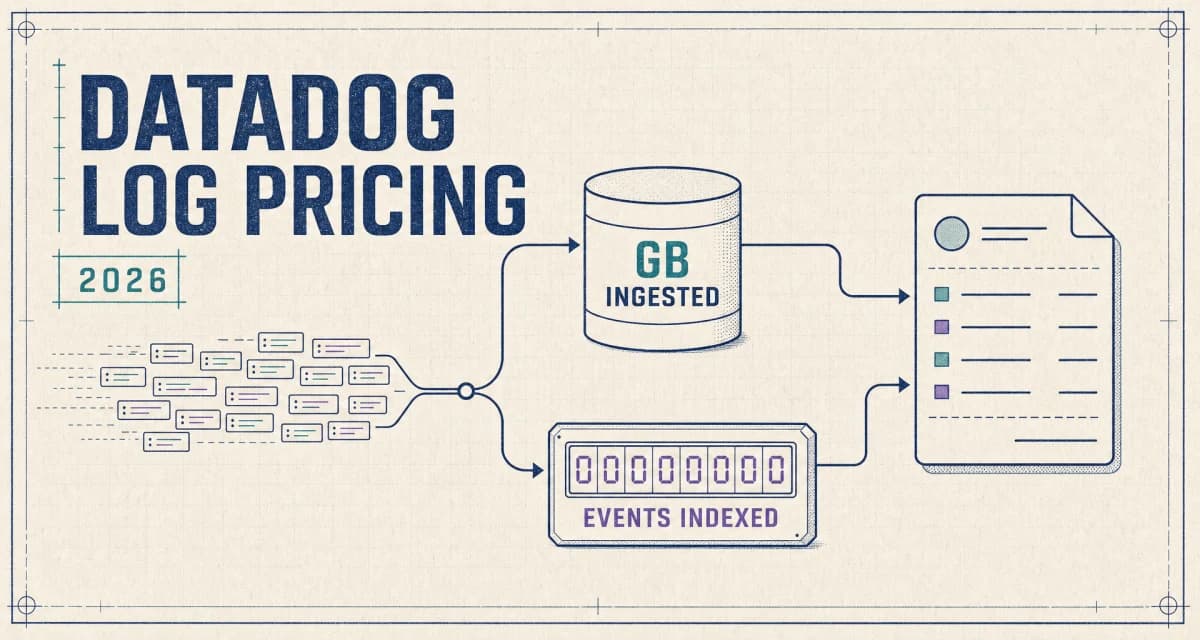
Datadog log pricing has two main meters: the volume you ingest and the number of events you index. That distinction matters. Ingestion is charged per GB, while Standard Indexing is charged per million events at a rate set by the retention period.
Using Datadog's published US annual rates, ingesting logs costs $0.10 per GB. Standard Indexing costs $1.06 per million events for 3-day retention, $1.27 for 7 days, $1.70 for 15 days and $2.50 for 30 days. Monthly and on-demand rates are higher.
This guide explains the model, calculates representative costs at 100 GB, 500 GB and 1 TB per day and shows which variables have the largest effect on the bill.
Short answer: Datadog log cost depends less on GB alone than many teams expect. Average event size, the percentage of events indexed, retention, contract type and optional products can materially change the result.
Datadog log pricing at a glance
These are the published US list prices used in this article. They exclude negotiated discounts, taxes, cloud storage charges and other Datadog products.
| Component | Annual commitment | Monthly | On demand | Billing unit |
|---|---|---|---|---|
| Log ingestion | $0.10 | $0.10 | $0.10 | Per ingested GB |
| Standard Indexing, 3 days | $1.06 | $1.27 | $1.59 | Per 1 million events |
| Standard Indexing, 7 days | $1.27 | $1.52 | $1.91 | Per 1 million events |
| Standard Indexing, 15 days | $1.70 | $2.04 | $2.55 | Per 1 million events |
| Standard Indexing, 30 days | $2.50 | $3.00 | $3.75 | Per 1 million events |
| Flex Logs Storage | $0.05 | $0.06 | $0.075 | Per 1 million events stored per month |
| Flex Logs Starter | $0.60 | $0.72 | $0.90 | Per 1 million events stored per month |
| Log rehydration scan | $0.10 | $0.10 | $0.10 | Per compressed GB scanned |
| Log forwarding | $0.25 | $0.25 | $0.25 | Per GB per custom destination |
| Observability Pipelines | $0.095 | $0.10 | $0.12 | Per ingested GB |
| Sensitive Data Scanner | $0.30 | $0.36 | $0.45 | Per scanned GB |
Source: Datadog's published pricing list. Check the pricing page and your contract before making a purchasing decision.
How Datadog log pricing works
The bill starts with ingestion, but searchable retention is where the larger variable usually appears.
Log ingestion is charged per GB
Datadog charges for every GB it ingests. At the published rate of $0.10 per GB:
- 100 GB per day costs about $300 per 30-day month.
- 500 GB per day costs about $1,500 per month.
- 1 TB per day costs about $3,000 per month.
This charge applies before deciding which events to index. Filtering unnecessary events before they reach Datadog can therefore reduce both ingestion and downstream processing costs.
Standard Indexing is charged per event
Indexed events can be searched in Log Explorer and used for analysis and alerting. Datadog bills Standard Indexing per million events, not per GB. The rate increases with the selected retention period.
Event size connects the two billing units. A GB containing one million 1 KB events costs much more to index than a GB containing one thousand 1 MB events. Two teams sending the same number of gigabytes can receive very different bills.
For rough planning:
events per month = GB per day × 30 × events per GB

indexed events = events per month × indexed percentage

monthly log cost = ingestion cost + indexing cost
Use the actual event count from your logs whenever possible. A 1 KB average event is convenient for examples, but production event sizes vary widely.
Retention changes the indexing rate
Retention is not a separate surcharge added to Standard Indexing. It determines the per-million-event indexing rate. Under an annual commitment, Datadog lists $1.06 for 3 days, $1.27 for 7 days, $1.70 for 15 days and $2.50 for 30 days.
That makes retention a direct cost lever. The trade-off is operational: shortening searchable retention may make older incidents harder to investigate.
Archives, rehydration and Flex Logs solve different problems
Datadog supports archives in customer-owned object storage. Archived logs are cheaper to retain, but they are not continuously available in the Standard Index. Archive Search can scan an archive without rebuilding an index. Rehydration scans the selected archive data and returns matching events to an index. Datadog charges $0.10 per compressed GB scanned, then applies the contracted indexing rate to matching events.
Flex Logs provides a separate long-retention path. Flex Logs Storage bills stored events, while Flex Logs Starter bundles storage and a defined amount of query compute. Flex does not support every Standard Index feature. For example, Datadog documents limitations around monitors and Watchdog, so it should not be treated as a drop-in replacement for every operational log.
The practical choice is usually a mix:
- Keep high-value operational events in Standard Indexing.
- Put infrequently queried history in Flex Logs or an archive.
- Rehydrate only the time range needed for an investigation.
Adjacent products create separate meters
Infrastructure monitoring, APM, RUM, custom metrics, security products, Observability Pipelines, data scanning and forwarding have their own pricing. They may appear on the same invoice, but they should not be folded into a log-pricing calculation unless the workload actually uses them.
That boundary matters. A log-only estimate should model logs first, then add adjacent products as separate line items.
A practical Datadog log cost calculator
The examples below use these assumptions:
- 30-day month
- 1 KB average event size or about 1 million events per GB
- 20% of ingested events indexed
- 30-day Standard Index retention
- annual commitment pricing
- no contract discount
At 30-day retention, the published annual rate is $2.50 per million indexed events.
| Daily volume | Ingestion per month | Events per month | Indexed events at 20% | Indexing per month | Estimated total per month | Estimated total per year |
|---|---|---|---|---|---|---|
| 100 GB | $300 | 3 billion | 600 million | $1,500 | $1,800 | $21,600 |
| 500 GB | $1,500 | 15 billion | 3 billion | $7,500 | $9,000 | $108,000 |
| 1 TB | $3,000 | 30 billion | 6 billion | $15,000 | $18,000 | $216,000 |
These are planning examples, not quotes. If your average event is 500 bytes, the same GB volume contains roughly twice as many events. If it is 2 KB, it contains roughly half as many. Monthly or on-demand pricing also raises the indexing rate.
How the indexed percentage changes the bill
Indexing strategy matters more than ingestion volume in this model. For 100 GB per day, 1 KB events, 30-day retention and annual pricing:
| Indexed share | Indexed events per month | Ingestion | Indexing | Estimated monthly total |
|---|---|---|---|---|
| 5% | 150 million | $300 | $375 | $675 |
| 20% | 600 million | $300 | $1,500 | $1,800 |
| 50% | 1.5 billion | $300 | $3,750 | $4,050 |
| 100% | 3 billion | $300 | $7,500 | $7,800 |
Reducing the indexed share from 100% to 20% cuts this example from $7,800 to $1,800 per month. That saving comes with a cost of its own: excluded events are no longer available in the Standard Index. Teams need a deliberate routing policy, not a blanket exclusion rule.
Costs that are easy to miss
The headline rates do not describe every production bill. Check these items before approving a forecast.
Average event size
Because ingestion uses GB and indexing uses event count, event size is the bridge between them. Estimate it from representative production data rather than one service or one quiet day.
Multiple indexes and routing rules
Different indexes can use different retention periods. Poor routing can send the same kind of event into a more expensive retention tier than intended. Review exclusion filters and index order together.
Rehydration during incidents
Rehydration makes archived events searchable again, but it creates scan and indexing charges. Broad time windows and repeated investigations can turn an occasional workflow into a recurring cost.
Forwarding and preprocessing
Custom forwarding destinations, Observability Pipelines and Sensitive Data Scanner introduce per-GB charges. These features may be worth paying for, but they belong in the model if the architecture depends on them.
Query compute for Flex Logs
Flex Logs separates economical storage from query compute. Starter includes an allowance; other arrangements may bill compute separately. Model expected scan patterns alongside retention volume.
Contract terms
Annual, monthly and on-demand rates differ. Enterprise agreements may include negotiated discounts or commitments that make public list prices a poor predictor of the invoice. Use list prices for comparison, then replace them with contracted rates before budgeting.
How to reduce Datadog log management costs
Cost control works best when it starts before ingestion and continues through retention.
Drop noise at the source
Health checks, repetitive debug messages and known low-value events are cheaper to remove before they cross a paid ingestion boundary. The OpenTelemetry Collector can filter, transform, sample and route telemetry before export.
Do not drop data only because it is large. First check whether anyone uses it for incidents, audit, security or compliance.
Measure event size and count separately
Track GB per day, events per day, average event size and the indexed percentage. A dashboard that shows only ingestion volume misses the largest variable in Standard Indexing.
Reserve Standard Indexing for operational data
Keep events that power alerts, dashboards and active investigations in the Standard Index. Route infrequently queried history to Flex Logs or an archive when the feature trade-offs are acceptable.
Shorten retention by use case
Not every index needs 30 days. A production error index may justify longer retention, while noisy development logs may not. Separate them instead of applying one retention policy to everything.
Put budget checks into the pipeline
Alert on daily GB, event count, indexed share and unexpected changes in event size. A deployment that starts emitting many small events can increase indexing cost even when total GB changes only slightly.
Datadog and Parseable cost comparison
Datadog and Parseable package log management differently, so a comparison needs explicit assumptions.
Parseable Cloud publishes a starting rate of $0.39 per ingested GB, with 365-day retention and query scanning up to 10 times ingestion included. Additional query scanning is listed at $0.02 per GB. Parseable OSS is free to self-host, but infrastructure and engineering time are not free.
Using the same 30-day month and only the published ingestion rate:
| Daily volume | Parseable Cloud per month | Parseable Cloud per year | Datadog at 20% indexed per year | Datadog at 100% indexed per year |
|---|---|---|---|---|
| 100 GB | $1,170 | $14,040 | $21,600 | $93,600 |
| 500 GB | $5,850 | $70,200 | $108,000 | $468,000 |
| 1 TB | $11,700 | $140,400 | $216,000 | $936,000 |
In this narrow model, Parseable Cloud is about 35% lower than Datadog when 20% of 1 KB events are indexed for 30 days. The gap becomes much larger when every event is indexed. It becomes smaller if Datadog indexes fewer events, uses shorter retention, applies a contract discount or routes history to Flex Logs.
This is not an equivalence claim. Compare the features your team uses, query workload, support, migration effort, data transfer and operational model. The broader log management tools comparison can help narrow the field. If Datadog remains on the shortlist, compare it with the other Datadog alternatives before running a proof of concept. Teams also evaluating Splunk can use the Datadog vs Splunk comparison to compare observability, SIEM and deployment alongside log costs.
A low-risk way to compare the platforms
Do not move production logging based on a spreadsheet alone. Run both systems against a representative slice of traffic for two to four weeks.
- Mirror the same logs to each destination.
- Record GB, event count, average event size, indexed share and retention.
- Replay real incident queries and measure latency.
- Verify alerts, access controls, audit requirements and recovery workflows.
- Include engineering effort and support in the cost model.
- Compare the predicted bill with actual metering data.
Compare the cost of meeting your team's search, retention and reliability requirements rather than the lowest line item. Teams that choose to move can use the Datadog migration guide to plan a parallel run and cutover.
How to estimate Datadog log cost accurately
The reliable way to forecast Datadog log pricing is to model GB and events separately. Start with ingestion volume, calculate events from measured average size, apply the indexed percentage and use the rate for the required retention period. Then add rehydration, forwarding, preprocessing and adjacent products only where the architecture uses them.
That model is less dramatic than a blanket cost-per-GB claim, but it is far more useful. It shows exactly which decision changes the bill and gives engineering teams a practical place to start optimizing.