Coding agents are shipping real value. AI SRE is unfortunately not moving beyond demos. The difference comes down to stakes and proximity to production.
The framing gap
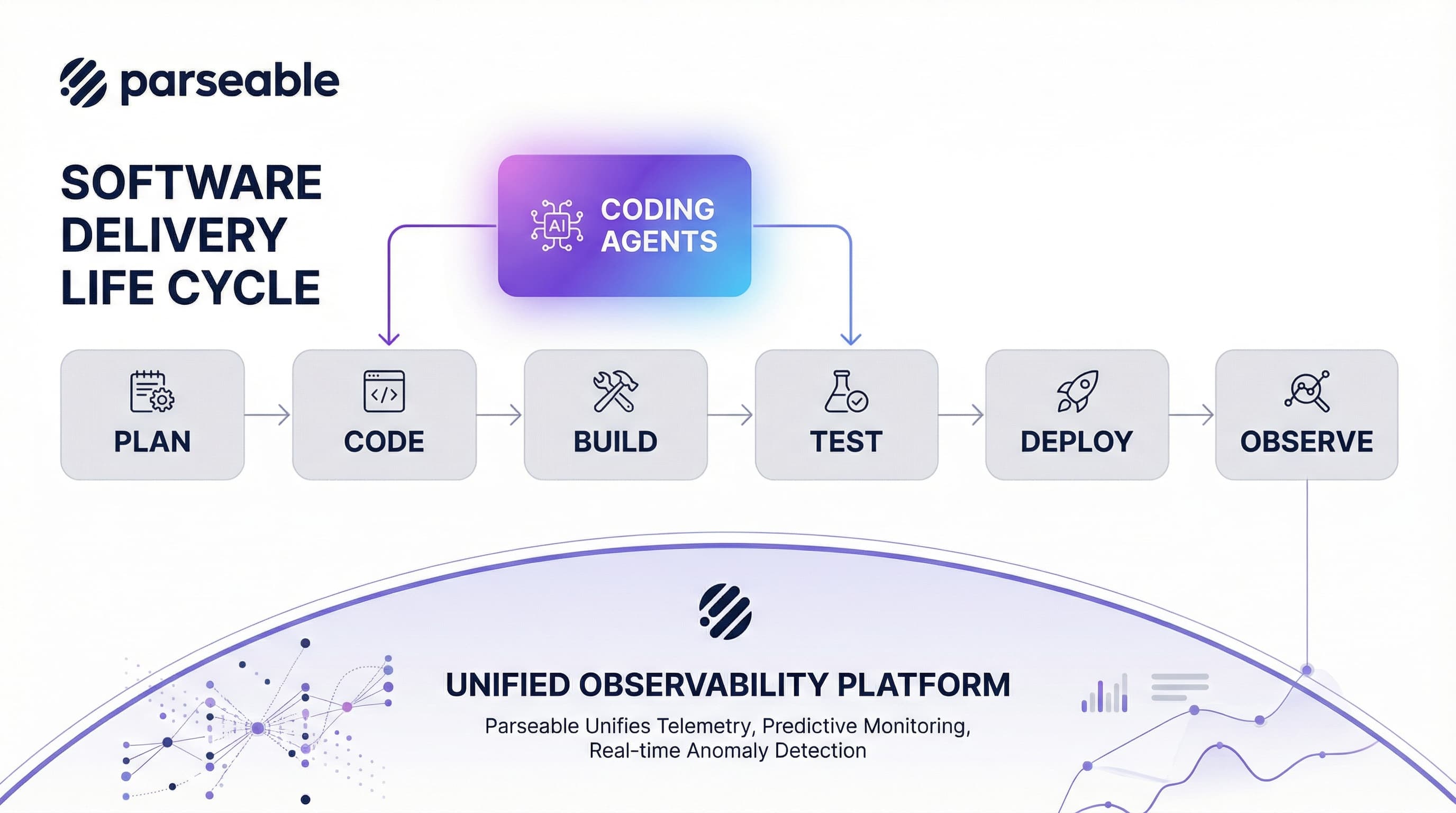
Software development gave us "coding agents" — AI that assists developers, speeds up iteration, all the while staying in its lane. If you've used a coding agent, you already know the experience. It fits into the developer's workflow so well, and adds clear, immediate value. This has irrevocably changed how software is built.
Observability, however, pushed "AI SRE" — the framing here implies that AI will fully handle the on-call experience, autonomously detecting, diagnosing, and remediating incidents. A tall order. The skepticism has been earned.
Why observability is different
The key difference is how far the workflow (where AI is applied) is from production systems.
AI-generated code goes through multiple checkpoints before it touches customers. Compilation catches syntax errors. Tests catch logic errors. Code review catches design errors. Staging catches integration errors. Each step is a gate, and bad output gets caught before it matters. Every step now has AI players making it faster.
The feedback loop is tight — code either compiles or it doesn't, tests pass or they fail. Experimentation is cheap, and rollback is easy.
AI SRE operates in a completely different environment. It activates during an incident, when stakes are already high and pressure is mounting. There's no staging environment for production outages. The feedback loop is your customers' experience.
If AI hallucinates during an incident, it can send you down irrelevant rabbit holes, restart the wrong service, misdiagnose root cause and extend MTTR, or trigger cascading failures that turn a minor issue into a major outage.
Even if we're willing to accept some level of risk, the feedback loop is slow and noisy. Did the AI help resolve the incident, or did human operators step in? Did the AI's suggestion actually improve MTTR, or did it just waste time chasing a red herring?
This asymmetry of consequences makes risk untenable in SRE world. A false positive in coding costs wasted time — maybe a few minutes of confusion before the developer course-corrects. A false positive in incident response costs extended downtime, customer impact, and trust erosion.
This is why the "AI SRE" framing has produced so much skepticism among practitioners. The people closest to the pain — the ones who actually carry pagers — understand intuitively that autonomous AI intervention during an incident is a liability.
Determinism and distance from production enable safe experimentation. AI SRE has neither.
Conversational approach works well
So where does AI actually help in observability?
Consider how debugging actually works. Three engineers on a 2am Zoom call. Four hours of "check this dashboard" and "can you grep that log." Form a hypothesis, test it, debunk it, iterate. Debugging is detective work — collaborative, conversational, iterative.
The value of AI right now, in this context, isn't autonomy. It's acceleration. What if you could have that back-and-forth with your observability stack directly?
This is the premise behind Parseable Keystone. Ask questions in plain English. Drill down with follow-ups. Get to root cause faster. The AI surfaces insights and connections across your telemetry data; you make the decisions. You maintain judgment; you just reach conclusions faster.
The outcome: fewer people on call, shorter incidents, confidence in every decision. No autonomous action, no hallucination risk in production, no replacing the human judgment that actually resolves incidents.
Final thoughts
The observability industry is chasing a framing that sounds impressive but struggles to ship real value. Meanwhile, the software industry's humbler approach — AI that assists rather than replaces — is delivering measurable productivity gains.
AI delivers when it augments human judgment, when it accelerates the work humans are already doing rather than attempting to replace the judgment calls that require context, experience, and situational awareness.
Uptimes improve when decisions are grounded in data and context. Vibes don't fix incidents.