
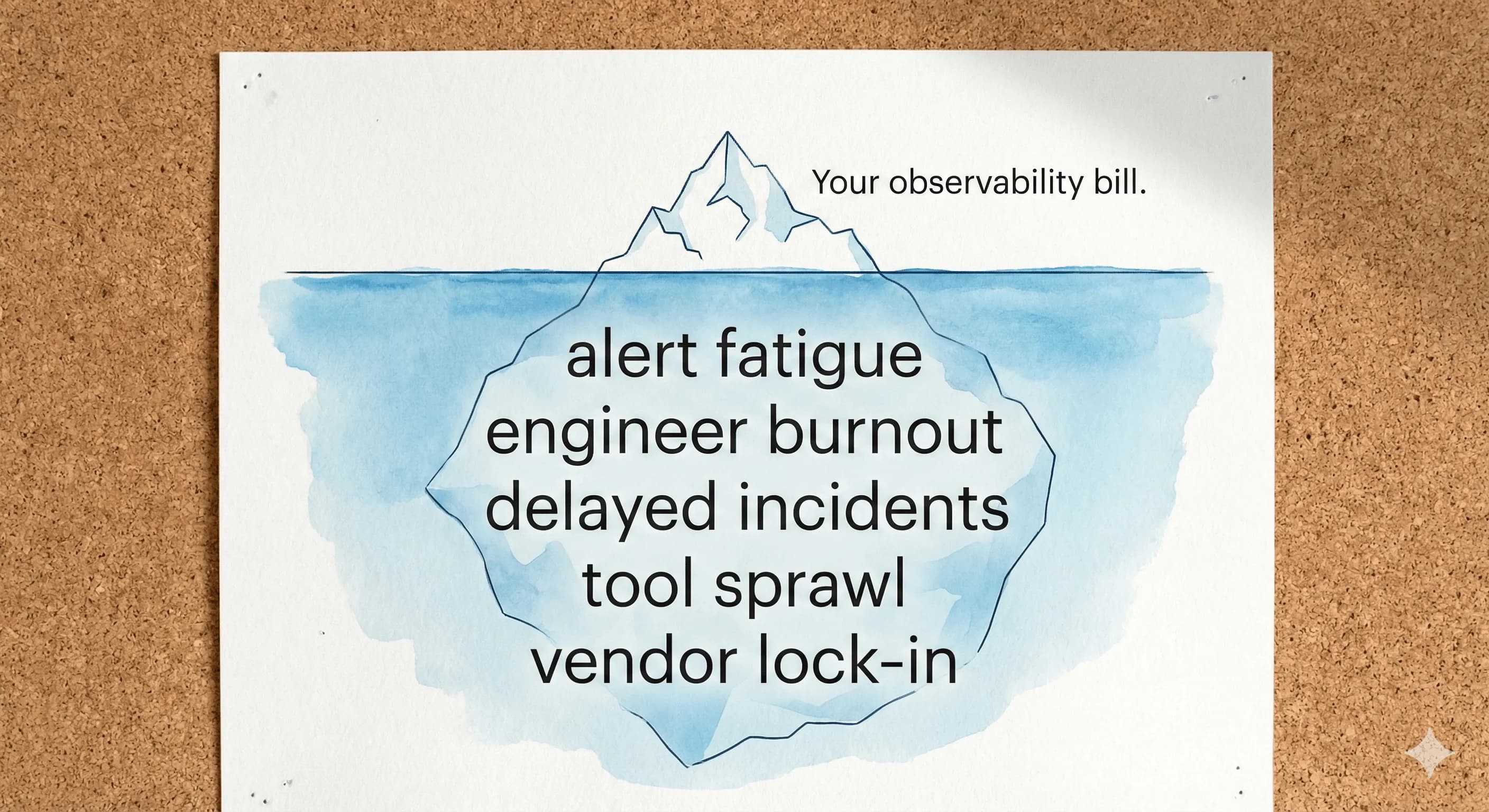
Observability as a practice is getting squeezed from three directions at once.
AI agents are generating telemetry at an extreme rate and cardinality. Agents generate a wide range of data points, all relevant for experimentation. While OpenTelemetry is working to standardize this through GenAI instrumentation SIG, the volume makes RoI harder to prove. Industry estimates put telemetry growth at roughly 30% annually, and that's before counting the digital exhaust from AI workloads.
Cost scrutiny is intensifying alongside this expansion. Organizations are waking up to the fact that costs grow linearly with telemetry volume, but value doesn't. 84% of organizations plan to consolidate observability tools in 2026. The economics of running multiple platforms at current data volumes are unsustainable, and AI workloads are about to make those volumes significantly larger.
Uptime expectations keep climbing. Customers expect always-on services and SRE teams face more reliability pressure than at any point in the last decade.
Each of these pressures is probably manageable in isolation. Together, they break architectures that were built for a different scale of data and a simpler set of signals.
The ecosystem has converged on features
The observability industry has landed on a common feature set. Dashboards, alerting, tracing, log search, anomaly detection — every major platform offers some version of these. Innovation continues at the edges, but core UI capabilities have converged.
When every platform offers similar capabilities, the differentiator moves down the stack. Architecture and data economics determine which platforms survive the squeeze and which buckle under it.
What separates platforms now is how efficiently the underlying engine handles volume and how long it can retain data without locking you in.
Cost is a concern now
We've had this conversation with engineering leaders over the past year. 75% of the users we spoke with in the last six months cited cost as their primary observability concern. Even teams comfortable with current spend foresaw problems as their data projections showed significant increases.
Teams are paying more for observability each year while retaining less data and getting slower queries. Most delete telemetry after 30 days because keeping it is economically irrational on their current platform.
Data is your moat
We think the industry has the retention question backwards — telemetry data gains value as it accumulates, and most platforms penalize you for keeping it.
The default retention window is typically 15 - 30 days for logs and traces. Metrics are kept around longer but get downsampled until granularity is gone.
Short retention is particularly costly for AI workloads. The models that detect anomalies and forecast failures need history to be accurate. A model watching your telemetry for 12 months can distinguish a real degradation from normal variance and predict capacity from actual growth curves.
With open weight models like Llama, Mistral, and DeepSeek making it practical to run capable models against your own data, the teams that retain more telemetry will build better operational intelligence than those that don't.
If your observability includes user-facing data like RUM, long retention gives you months of real user behavior. Feed that to an LLM and you can surface patterns that no dashboard would have revealed.
Twelve months of full-resolution data across logs, metrics, and traces is enough to train anomaly detection on your own baselines and build incident pattern recognition that understands your specific failure modes.
Data retention is a competitive advantage once the economics make sense. We wrote about this in detail in Data Is Your Moat.
Data silos leak value
Observability needs to be unified to be useful.
Across industries, the pattern has been consolidation of signals into a single system to correlate better and manage costs. Organizations consolidating tools are eliminating silos, not trimming features.
The same pattern is playing out in agent observability. When we first started running AI systems in production, we thought observability was a solved problem. We had dashboards, metrics, logs, tracing, and alerts already. Maybe we needed to add another dashboard for token usage to make sure we didn't have to mortgage the office space, but it seemed straightforward.
Then we started seeing unexpected behavior that didn't line up with a wall of 500s or an outage. An agent still completes tasks, but takes longer and costs more tokens. A model update subtly changes the output, and downstream services start handling more edge cases. Infrastructure pressure causes intermittent slowdowns, and agent behavior shifts under latency. Nothing crashes, but no single metric explains the change.
Agent observability platforms have emerged to address this, offering dashboards built for agents with token usage controls and guardrails for nondeterministic behavior. These tools do real work at the application layer. What they deliver, though, is local visibility. You can see what an agent did in a single run, inspect prompts, tool calls, and token counts.
Any issue that involves your infrastructure or other services still means correlating data across separate tools. And the volume from hundreds of agents making thousands of tool calls is substantial, with the rest of your telemetry sitting somewhere else entirely.
When an agent fails in production, the root cause is rarely contained in the agent layer alone. The model returned slowly because the database underneath was degraded. An upstream API rate limit caused the tool invocation to time out. Solving these problems requires the same cross-signal correlation that the broader observability industry has been moving toward for years.
If observability data is datalake-shaped, it should be in a datalake. Infrastructure logs, application traces, AI agent telemetry, and metrics belong in the same store, queryable together, retainable together.
Architecture makes all of this possible
Parseable is purpose built as a telemetry datalake on object storage. Object storage is the only tier that makes long-term, high-volume telemetry retention economically rational. But building on object storage requires rethinking the entire data path from ingestion through query execution.
You can't take a database designed for local disk and point it at S3. The access patterns and latency profile differ.
Compute-storage separation. Ingestion nodes, query nodes, and storage are independent. No data replication across expensive EBS volumes. Nodes scale horizontally without cluster coordination overhead.
Columnar Parquet format. Telemetry data compresses up to 90% (75% average) in columnar layout. Analytical queries only read the columns they need, which cuts both I/O and cost. The format is open, readable by Spark, DuckDB, Athena, or anything else that speaks Parquet.
Efficient compression. Most observability platforms pre-index everything at ingest, which creates write amplification and inflates storage. Parseable uses efficient compression to get up to 85% compression for logs and traces while achieving over 90% compression for metrics data. Combined with object storage, this changes the economics of long-term retention entirely.
Vectorized query execution. SIMD-powered execution reduces CPU cycles per query. Combined with intelligent caching (hot data on SSD, cold data on S3), this delivers sub-second response on frequently accessed data and fast scans on historical data.
Rust core. No JVM overhead. 50% smaller compute and memory footprint under comparable workloads. When your observability platform needs to stay up while other systems are failing, resource efficiency isn't optional.
Parseable now ranks among the fastest databases on ClickBench. We've written about those benchmarks in detail — including the caveats about ClickBench not being an ideal observability workload test — in our Performance is Table Stakes post.
This architecture is what makes long retention and AI-powered analysis economically viable. The same data that costs a dollar to store on a legacy platform costs pennies on Parseable, because the format and access patterns are designed for object storage economics. Parquet on object storage with up to 90% compression drops storage costs by an order of magnitude. The data stays in open formats on storage you control, queryable by Parseable, Spark, DuckDB, Athena, or whatever else reads Parquet, with no lock-in or proprietary formats anywhere in the chain.
Parseable offers one of the longest included retention windows — up to 12 months on Pro, unlimited on Enterprise (with bring your own bucket) — for all three signal types at full resolution. It's backed by an architecture that makes it economically sustainable at any data volume.
Parseable Cloud: GA details
Parseable Cloud is now generally available.
Pro plan — $0.39 per GB ingested. Up to 12 months retention across logs, metrics, and traces. Includes all AI features: Keystone natural language queries, forecasting, anomaly detection, AI-assisted SQL generation. Unified observability across infrastructure, applications, and AI workloads in one datalake. Unlimited hosts, users, and dashboards. 14-day free trial, no credit card required.
Enterprise plan — Custom pricing. Bring your own bucket for unlimited retention. Dedicated infrastructure with data residency options. Deployment flexibility: Parseable Cloud, BYOC, or on-premises. Iceberg support, audit logging, team quotas, custom partitioning for sub-second queries, and dedicated support with SLA.
Self-hosted — Single binary deployment. Run on bare metal, VMs, or Kubernetes. Air-gapped environments supported. No limits on retention or volume.
The architecture is the same across all three — same engine, same open formats. The difference is who manages the infrastructure and what level of control you need.
Under the hood
Parseable Cloud runs on globally distributed object storage powered by Tigris, an S3-compatible storage platform.
We chose Tigris for specific technical reasons. Tigris automatically distributes data close to where it's accessed, with multi-region replication built in. There are no egress fees, which matters when you're querying terabytes of telemetry across regions. And when a region goes down, writes route to the nearest healthy region while reads keep flowing from healthy endpoints.
Your observability platform needs to be available when your infrastructure is having problems. If the storage layer underneath your telemetry goes down during the outage you're trying to diagnose, you lose visibility during the incident that matters most. Tigris's multi-region architecture means Parseable Cloud stays available during regional infrastructure failures.
The full stack: Parseable (Rust, Parquet, vectorized queries) on Tigris (globally distributed, zero-egress S3), with native OpenTelemetry ingestion. No proprietary formats anywhere in the pipeline.
Parseable Cloud is SOC2 Type 1 certified, with GDPR and SOC2 Type2 coming soon. Review Parseable Trust Centre for more information.
Try it
If you're running AI workloads and struggling with fragmented telemetry across multiple tools, try Parseable Cloud. The free trial gives you full Pro access for 14 days — unified observability across all signal types, with the retention depth that AI-powered analysis requires.
If you'd rather see it first, we'd like to show you what a telemetry datalake looks like against your stack. Talk to us.