If your team is evaluating CloudWatch alternatives, the frustration driving that search is almost always one of a handful of the same things: a bill that grew faster than your infrastructure, a platform that only sees AWS resources, query costs that discourage ad-hoc investigation, or the realization that a tool tied to one cloud cannot be the foundation of a multi-cloud observability strategy.
This guide is for engineering teams, platform engineers, and DevOps practitioners who rely on AWS infrastructure today but want to make an informed, forward-looking decision about their observability stack. We cover ten of the most credible AWS CloudWatch alternatives, evaluated across pricing model, multi-cloud support, OpenTelemetry compatibility, deployment flexibility, query experience, and real operational trade-offs.
Each tool is described honestly, with verified pricing and genuine limitations, so you can match the right CloudWatch alternative to your actual requirements rather than a vendor's best-case pitch.
TL;DR
- AWS CloudWatch charges at every step: log ingestion, log storage, log scanning, custom metrics, alarms, and dashboards. A mid-size Kubernetes cluster can cross $10,000/month before you add any custom instrumentation.
- CloudWatch is AWS-only. The moment your stack touches GCP, Azure, or on-prem, you're flying blind.
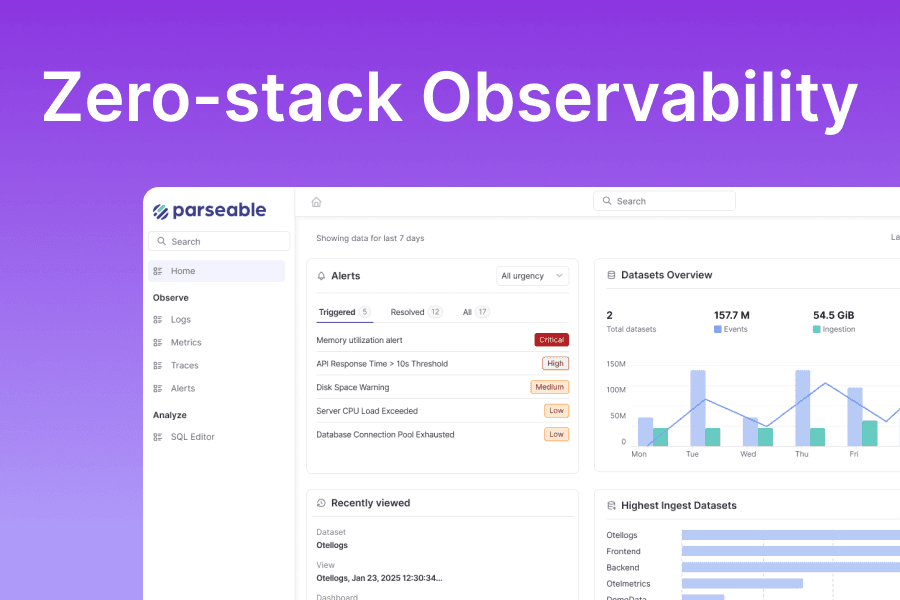
- Parseable is a unified observability platform, allowing logs, metrics, and traces on your own S3, ingests via OpenTelemetry, and queries in SQL or plain English. No per-metric billing, no vendor lock-in.
- Switching from CloudWatch to Parseable doesn't require re-architecting your instrumentation. OTel replaces the CloudWatch agent. S3 replaces AWS-managed storage. SQL replaces Logs Insights syntax.
Why teams look for CloudWatch alternatives
Amazon CloudWatch is deeply integrated into the AWS ecosystem and covers logs, metrics, alarms, dashboards, and application performance signals within a single native service. For teams running workloads entirely on AWS and monitoring only AWS-native resources, it works well. The reasons teams start evaluating CloudWatch alternatives are structural.
-
AWS-only scope: CloudWatch is designed for AWS resources. Teams running multi-cloud workloads, on-premises infrastructure, or hybrid architectures cannot bring non-AWS telemetry into CloudWatch without significant engineering effort. A platform that only sees one cloud is not a viable long-term observability foundation for most modern infrastructure stacks.
-
Pricing complexity and unpredictability: CloudWatch charges across multiple separate dimensions. Log ingestion is $0.50/GB beyond the 5GB free tier. Log storage runs $0.03/GB/month. Custom metrics cost $0.30 per metric per month beyond the 10 free metrics. Logs Insights queries cost $0.01 per 1,000 metrics analyzed. Alarms, dashboards, and contributor insights all carry additional per-unit charges. Teams that instrument heavily or run frequent ad-hoc log investigations find that costs compound in ways that are difficult to predict from month to month.
-
Custom metric cost at scale: The $0.30/metric/month charge for custom metrics is one of the most frequently cited pain points. For teams instrumenting microservices, Kubernetes workloads, or business-level metrics, the custom metric count can reach tens of thousands, turning a seemingly minor line item into a significant budget concern.
-
Log query costs that limit exploration: CloudWatch Logs Insights charges per query execution. For teams that want to run ad-hoc investigations freely, the per-query pricing model creates a friction that discourages the kind of exploratory querying that good observability practice requires.
-
Open standards friction: CloudWatch has added OpenTelemetry support over time, but it was not built around OTel from the ground up. Teams adopting OTel as their primary instrumentation standard often prefer a platform where OTLP is the native input rather than an additional integration path.
-
Vendor lock-in: CloudWatch stores data in AWS-proprietary formats and uses its own query syntax for Logs Insights and Metrics Insights. Migrating historical data or rebuilding dashboards when moving to a different platform is a significant effort. Understanding the true cost of observability goes beyond the per-GB headline rate and includes the switching cost of proprietary data formats.
What to look for in a CloudWatch alternative
The right CloudWatch replacement depends on which of the above limitations is causing the most friction for your team.
-
Multi-cloud and hybrid coverage: If AWS-only scope is the driver, prioritize platforms that ingest telemetry from GCP, Azure, on-premises, and bare-metal infrastructure natively without requiring a per-cloud connector for every source.
-
Predictable pricing model: Look for platforms with transparent, predictable pricing. Flat per-GB ingestion pricing is easier to forecast than a combination of per-host, per-metric, per-query, and per-alarm charges. Be especially careful about log query costs: some platforms charge per query execution while others include queries in the base ingest cost.
-
OpenTelemetry-native ingestion: If your team is adopting OTel for instrumentation, your observability backend should accept OTLP natively. This eliminates the need for an intermediate agent layer and keeps your instrumentation portable.
-
Deployment flexibility: SaaS-only platforms limit data residency options. If your team operates under data sovereignty, compliance, or regulatory requirements, look for platforms that offer BYOC (bring your own cloud) or self-hosted deployment alongside a managed cloud option.
-
Unified logs, metrics, and traces: CloudWatch provides log and metric support with some APM capabilities via Application Signals. A platform that can replace CloudWatch fully should handle logs, metrics, and traces in a single interface, reducing context switching during incident response.
-
Query language and analyst accessibility: CloudWatch Logs Insights uses a proprietary query syntax. SQL-based alternatives are accessible to a much wider pool of engineers and analysts without dedicated training.
10 Best CloudWatch Alternatives in 2026
| Tool | Best For | AWS-Native Fit | Multi-cloud | OTel Support | Self-hosted / BYOC | Query Language | Pricing Model | Main Trade-off |
|---|---|---|---|---|---|---|---|---|
| Parseable | Cloud-native unified observability | Via agents / OTLP | Yes | Native OTLP | Yes (OSS, BYOC, Cloud) | SQL + Natural Language | Per GB ingested | Newer ecosystem |
| Datadog | APM-first cloud observability | Strong AWS integration | Yes | Yes | No (SaaS only) | Datadog query language | Per host + per GB | Very expensive at scale |
| Grafana Cloud | Open source metrics and logs | AWS integrations | Yes | Via OTel Collector | Yes (OSS, Cloud) | PromQL, LogQL | Per series + per GB | Engineering overhead |
| New Relic | Usage-based full-stack observability | AWS integrations | Yes | Yes | No (SaaS only) | NRQL | Per GB + per user | Per-user seat pricing |
| Elastic | Full-text log search at scale | Via Filebeat / agents | Yes | Yes | Yes (self-hosted, Cloud) | DSL, EQL, KQL | Compute + storage | Operational complexity |
| Splunk | Enterprise SIEM and observability | AWS integrations | Yes | Via add-ons | Yes (on-prem, cloud) | SPL | Workload/ingest/activity | Very high cost |
| Dynatrace | AI-driven full-stack monitoring | AWS auto-discovery | Yes | Yes | Limited (primarily SaaS) | DQL | Per host + per GB | Pricing complexity |
| Prometheus + Grafana | Self-hosted metrics monitoring | Via exporters | Yes | Via OTel Collector | Yes (self-hosted) | PromQL / LogQL | Infrastructure cost only | No native log storage |
| Honeycomb | Distributed tracing and event analytics | Via OTel | Yes | Native | No (SaaS only) | Honeycomb Query Language | Per event/month | Not a full log platform |
| Logz.io | Cloud-native log management on ELK | AWS integrations | Yes | Yes | No (SaaS only) | Lucene / Kibana DSL | Per GB/day ingested | Can be expensive at volume |
1. Parseable: Best Open-Source CloudWatch Alternative
Parseable is a cloud-native observability platform built for teams that want to move beyond CloudWatch’s AWS-only model and fragmented pricing. It unifies logs, metrics, and traces in one platform, stores telemetry in Apache Parquet on S3-compatible object storage, and supports querying in SQL or plain English.
Where CloudWatch requires you to stay within AWS query syntax and proprietary dashboarding, Parseable offers SQL-based analysis and natural language querying. Meaning, your engineers, analysts, and on-call teams can query telemetry in plain English or write SQL without a dedicated training program.
Anouther factor that gives Parseable a clear advantage over Cloudwatch is it' Deployment flexibility. Our open source version (Parseable OSS) runs self-hosted on Docker, Kubernetes, or any major cloud. We also offer Parseable Cloud, which is a fully managed offering. And our BYOC runs Parseable infrastructure inside your own AWS, GCP, or Azure account, giving you the operational simplicity of a managed service without giving up data residency control.
What makes Parseable an ideal CloudWatch alternative
- Unified logs, metrics, and traces: CloudWatch splits observability across multiple AWS services and workflows. Parseable brings logs, metrics, and traces into one platform, which makes troubleshooting faster and reduces context switching during incidents.
- OpenTelemetry-native ingestion: Parseable supports OTLP over HTTP and gRPC and integrates directly with the OpenTelemetry Collector. For teams standardizing on OTel, that makes migration from CloudWatch much cleaner than staying tied to AWS-specific collection patterns.
- Open storage on S3-compatible object storage: Instead of keeping telemetry inside an AWS-managed observability product, Parseable stores data in Apache Parquet on S3-compatible object storage. That gives teams more control over retention, portability, and long-term data access.
- SQL and natural language querying: CloudWatch requires teams to work with Logs Insights syntax and separate AWS workflows. Parseable supports SQL and AI-enabled SQL generation from natural language, which makes querying easier for a wider set of engineers and analysts.
- Better fit for multi-cloud and hybrid environments: CloudWatch is AWS-centric by design. Parseable is a better fit if your telemetry comes from AWS, Kubernetes, streaming systems, containers, or other cloud environments and you want all of it in one place.
- Built-in anomaly detection and forecasting: Parseable goes beyond basic storage and search. Its platform includes anomaly detection, forecasting alerts, and AI-native analysis, which helps teams move from reactive monitoring to earlier issue detection.
Pricing:
- OSS: Free, self-hosted, no licensing
- Pro: $0.39/GB ingested, 365-day retention, 14-day free trial
- Enterprise plan that comes with dedicated infrastructure, BYOC, self-hosted, and Iceberg support.
- Additional query scanning beyond 10x monthly ingest: $0.02/GB
Ready to move beyond CloudWatch's per-metric billing? Try Parseable free with the OSS version or start a 14-day Pro trialp with no commitment.
2. Datadog
Datadog is the dominant SaaS observability platform for cloud-native engineering teams and one of the most commonly evaluated CloudWatch alternatives for teams that want a single platform to replace AWS-native monitoring with broader, multi-cloud visibility. It unifies infrastructure monitoring, APM, log management, real user monitoring, synthetic testing, and Cloud SIEM in one product suite.
As a CloudWatch alternative, Datadog's main advantage is depth of AWS integration alongside genuine multi-cloud coverage. Datadog's AWS integration pulls in CloudWatch metrics natively, so teams can start by running both in parallel before cutting over. The APM and log correlation experience is strong: pivoting from a slow trace to correlated logs without switching tools is genuinely useful during incident response.
The honest trade-off is cost. Datadog's pricing is multi-dimensional in a way that makes it difficult to forecast. Infrastructure monitoring charges per host, log management charges per ingested GB and per indexed event separately, APM charges per host on top of infrastructure, and Cloud SIEM is an additional module. Teams that enable the full feature set needed to replace CloudWatch frequently find annual spend reaching $50,000 to $150,000+ for mid-sized infrastructure. There is no self-hosted option.
Pricing:
- Infrastructure Pro: $15/host/month (annual)
- Infrastructure Enterprise: $23/host/month (annual)
- Log ingestion: $0.10/GB/month
- Standard log indexing (15-day retention): $1.70/million log events/month
- APM Base: $31/host/month (with infrastructure, annual)
- Free tier: up to 5 hosts, 1-day metric retention
Pros:
- Best-in-class AWS integration; ingests CloudWatch metrics natively for side-by-side migration
- Strong APM with seamless log and trace correlation
- Cloud SIEM available as an add-on
- Wide multi-cloud and on-premises coverage
Cons:
- Multi-dimensional pricing (per host, per GB, per indexed event, per module) makes cost forecasting unreliable
- SaaS only; no self-hosted or BYOC option limits data residency control
- Full feature parity with what CloudWatch provides across logs, metrics, and APM costs significantly more
- Proprietary query language creates migration lock-in
- Agent overhead compounds on large Kubernetes environments
3. Grafana Cloud: Open Source CloudWatch Alternative for Metrics and Logs
Grafana Cloud is the managed version of the Grafana observability stack: Loki for logs, Mimir for Prometheus-compatible metrics, Tempo for traces, and Grafana for dashboards and visualization. As a CloudWatch alternative, Grafana Cloud appeals most to teams already using open source Grafana and Prometheus who want to extend that stack to logs and traces without operating it themselves.
The open source credentials are genuine. Loki, Mimir, and Tempo are all Apache-licensed, which means teams can run the entire stack self-hosted at no licensing cost. The self-hosted path is a meaningful CloudWatch alternative for teams that want full data control, particularly given Grafana's broad AWS integration support, but it requires significant platform engineering to operate at scale.
Pricing:
- Free tier: 10k metric series/month, 50GB logs/month, 50GB traces/month, 14-day retention
- Pro: $19/month platform fee plus $6.50/1k metric series and $0.50/GB logs ingested, 30-day retention
- Enterprise: $25,000/year minimum, custom pricing and retention
Pros:
- Grafana is the most widely adopted open source dashboard and visualization tool in observability
- Full open source self-hosted path (Loki, Mimir, Tempo) with no licensing cost
- Generous free tier for evaluation and small teams
- Strong OTel support via the OpenTelemetry Collector
- Excellent AWS, GCP, and Azure integrations for multi-cloud observability
Cons:
- Self-hosting the full stack is operationally complex; not a simple CloudWatch drop-in
- Loki's label-only indexing makes full-text search on unindexed log fields slow at query time
- LogQL has a learning curve and is not as widely known as SQL
- Grafana Cloud costs scale with metric series count, which can grow unexpectedly in Kubernetes environments
- No native SIEM capabilities for teams with security monitoring requirements
4. New Relic
New Relic repositioned its pricing model in 2020 from per-host to a consumption-based model tied to data ingest volume and user seats. For teams evaluating CloudWatch alternatives with unpredictable or difficult-to-forecast costs, the New Relic model is often more transparent: you pay for GB ingested and for full platform user seats, not for hosts, custom metrics, or per-query execution.
The 100GB/month free ingest tier is a genuine differentiator that makes New Relic one of the most accessible CloudWatch alternatives for smaller teams or teams at the beginning of a migration. For those logging at moderate volume, New Relic can function as a zero-cost observability platform. Beyond the free tier, $0.40/GB applies uniformly across logs, metrics, and traces.
New Relic's limitations as a full CloudWatch replacement center on SaaS-only delivery and per-user pricing. Teams with many engineers will find that full platform user seats at $349/user/year inflate total cost significantly. The platform also lacks strong SIEM capabilities, making it a better CloudWatch alternative for observability-focused teams than for security operations teams.
Pricing:
- Free: 100GB/month ingest, 1 full platform user, unlimited basic users
- Beyond free: $0.40/GB (Original data) or $0.60/GB (Data Plus, with extended retention and governance)
- Standard: $10/first full user, $99/additional (max 5 full users)
- Pro: $349/user/year (annual) or $419/user/month (monthly)
- Enterprise: Custom pricing
Pros:
- 100GB/month free ingest is practically useful for small teams and proof-of-concept migrations
- No per-host or per-custom-metric charges; consumption model is simpler to understand than CloudWatch
- Unified platform covers APM, infrastructure, browser, mobile, and logs
- Good OpenTelemetry support with guided onboarding flows
- AWS, GCP, and Azure integrations for multi-cloud coverage
Cons:
- SaaS only; no self-hosted or BYOC deployment option
- NRQL is proprietary and adds a learning curve for teams accustomed to SQL or CloudWatch Logs Insights syntax
- Per-user seat pricing (Pro at $349/user/year) inflates costs for larger engineering teams
- $0.40/GB beyond the free tier is relatively high for log-heavy workloads at scale
- Limited SIEM capabilities; not a CloudWatch alternative for security operations teams
Comparing Parseable and Datadog as CloudWatch alternatives? See how Parseable's ingestion-based pricing compares when you want predictable costs without per-host or per-indexed-event charges.
5. Elastic: CloudWatch Alternative for Full-Text Log Search at Scale
Elastic and the ELK Stack (Elasticsearch, Logstash, Kibana) represent the most widely deployed open source alternative to CloudWatch for teams that prioritize full-text search capability across large log volumes. Elasticsearch as a search engine is best-in-class for unstructured text search, making it the preferred CloudWatch alternative for teams where log search quality and speed are the primary requirements.
Elastic Security extends the platform into SIEM territory with threat detection, UEBA, and endpoint protection, making it one of the few CloudWatch alternatives that can serve both observability and security operations teams from a single platform.
The trade-off is operational complexity. Running Elasticsearch well requires JVM heap tuning, shard management, index lifecycle policies, and ongoing cluster health monitoring. Self-hosted ELK at scale is a significant platform engineering commitment. Elastic Cloud reduces that overhead but carries pricing that scales steeply with data volume. Elastic's licensing also changed in 2021 to the Elastic License 2.0 and SSPL, which restricts certain commercial self-hosting scenarios.
Pricing: Elastic offers a free open source tier for self-hosted deployments. Elastic Cloud provides serverless and hosted managed options, both accessible via free trial. Pricing scales with compute and storage consumed as serverless and hosted configurations carry different pricing structures.
Pros:
- Industry-leading full-text search performance across large log volumes
- Large, mature open source community with extensive tooling and documentation
- Elastic Security provides genuine SIEM capabilities (threat detection, UEBA, endpoint protection)
- Multiple deployment options: self-hosted OSS, Elastic Cloud serverless, and hosted
- Strong OTel compatibility and broad AWS integration options
Cons:
- Self-hosted Elasticsearch requires dedicated expertise for JVM tuning, shard strategy, and cluster management
- Licensing changed in 2021 (SSPL / Elastic License 2.0), creating ambiguity around open source commercial use
- Elastic Cloud costs scale steeply with ingest volume
- Query DSL is complex for non-specialists; higher learning curve than SQL-based alternatives
- Multi-component architecture adds operational overhead versus a unified platform
6. Splunk
Splunk is the incumbent enterprise platform for security information and event management (SIEM) and log analytics. For large organizations evaluating CloudWatch alternatives with a security operations requirement, Splunk remains the most recognized name, particularly in regulated industries where its compliance certifications and partner ecosystem carry institutional weight.
Splunk covers logs, metrics, traces, and security analytics under a unified platform. Its Search Processing Language (SPL) is powerful for complex analytical queries over large datasets, and its ecosystem of connectors, add-ons, and partner integrations is extensive. Teams evaluating Splunk as a CloudWatch alternative for security-focused use cases should also consider evaluating Splunk alternatives to understand where Splunk sits on the cost and capability spectrum.
Pricing: Splunk offers workload, ingest, and activity-based pricing models, however they don't disclose their pricing openly though a free cloud trial is available.
Pros:
- The most recognized enterprise SIEM and log analytics platform; strong institutional trust
- Powerful SPL query language for complex analytical workloads
- Extensive ecosystem of connectors, add-ons, and security content
- Strong compliance certifications relevant to regulated industries
- Available as on-premises, private cloud, or Splunk Cloud (managed)
Cons:
- Pricing is not publicly disclosed and requires sales negotiation; consistently reported as very high
- SPL is a proprietary language with a steep learning curve for teams without existing Splunk expertise
- High operational overhead for self-hosted deployments
- As a CloudWatch alternative for observability only (without security), it is frequently overkill and overpriced
- Vendor lock-in from SPL, proprietary data formats, and high switching costs
7. Dynatrace
Dynatrace is a premium enterprise observability and AIOps platform that competes with CloudWatch at the large-enterprise end of the market. Its Davis AI engine provides automated root cause analysis and causal dependency mapping that goes beyond threshold-based alerting, making Dynatrace one of the most technically differentiated CloudWatch alternatives for large, complex distributed systems.
Dynatrace's auto-instrumentation capabilities are particularly strong for Java/JVM environments, where it can generate full distributed traces without manual code instrumentation. Smartscape automatically maps topology across hosts, processes, services, and cloud resources including AWS. For enterprises evaluating CloudWatch alternatives that want minimal manual instrumentation and maximum automated insight, Dynatrace delivers.
The trade-off is cost complexity and primary SaaS delivery. Log analytics is billed separately from APM, and the choice between pay-per-query and bundled retention models requires careful planning. The full-stack monitoring price of $58/month per 8GiB host, combined with separate log ingestion costs, makes Dynatrace one of the more expensive CloudWatch alternatives when enabling the full feature set.
Pricing:
- Full-Stack Monitoring: $58/month per 8GiB host
- Infrastructure Monitoring: $29/month per host
- Log ingestion: $0.20/GiB
- Log retention (pay-per-query): $0.0007/GiB-day
- Log retention (bundled): $0.02/GiB-day (10-35 days included)
Pros:
- Davis AI provides genuine automated root cause analysis across complex distributed architectures
- Smartscape topology mapping automatically discovers and maps AWS and multi-cloud dependencies
- Grail data lakehouse provides unified storage for logs, metrics, and traces
- Strong auto-instrumentation for Java/JVM; minimal manual code changes required
- Security posture management and runtime vulnerability analytics available as add-ons
Cons:
- Pricing complexity makes cost estimation difficult; bill surprises are common, especially when combining log and APM modules
- Primarily SaaS with limited self-hosted deployment options
- DQL (Dynatrace Query Language) requires dedicated learning time
- Per-host pricing adds cost pressure in dynamic auto-scaling Kubernetes environments
- Over-engineered and overpriced for teams primarily seeking a CloudWatch replacement for log analytics
Exploring Parseable as a Dynatrace or CloudWatch alternative? Try Parseable for free and see how SQL-native querying and open S3-backed storage compare to per-host pricing models.
8. Prometheus + Grafana: Self-Hosted CloudWatch Alternative for Metrics Monitoring
The Prometheus and Grafana open source combination is the most widely deployed self-hosted CloudWatch alternative for teams focused primarily on metrics monitoring. Prometheus is a CNCF-graduated project (the second after Kubernetes) for dimensional time-series metrics with its own powerful query language (PromQL). Grafana is the de facto open source dashboard and visualization standard in observability.
Together, they form the go-to CloudWatch alternative for Kubernetes-native teams and infrastructure engineers who want metrics monitoring without per-metric charges or SaaS lock-in. Where CloudWatch charges $0.30 per custom metric per month, Prometheus stores all metrics locally with no per-metric licensing cost beyond infrastructure. Paired with the Grafana OSS dashboard, teams get a fully capable metrics monitoring and alerting stack at zero licensing cost.
The important limitation is scope: Prometheus is a metrics-only platform. It does not store or query logs natively. Teams seeking a full CloudWatch replacement that also covers log management need to pair Prometheus with Loki or another log backend. Self-hosting also requires planning for Prometheus storage scalability, high-availability configuration, and long-term retention which typically requires a remote write backend like Thanos or Cortex/Mimir.
Pricing: Both Prometheus and Grafana OSS are free and open source under the Apache 2.0 license. Infrastructure costs (storage, compute) are the only expense for self-hosted deployments.
Pros:
- Zero licensing cost; both Prometheus and Grafana are Apache 2.0 open source
- No per-metric charges; instrument as many custom metrics as your infrastructure requires
- PromQL is the most widely adopted metrics query language in cloud-native environments
- Native Kubernetes service discovery makes it the default choice for K8s monitoring
- Large community, extensive exporter ecosystem (hundreds of official and community exporters)
- Full data sovereignty; all data stays in your own infrastructure
Cons:
- Metrics only; does not replace CloudWatch's log management capability
- Self-hosting at scale requires high-availability configuration and a long-term storage backend (Thanos, Mimir, or Cortex)
- Prometheus's local storage is not designed for multi-year retention; additional tooling required
- Grafana OSS lacks enterprise features (SSO, access control, audit logs) without Grafana Enterprise or Grafana Cloud
- Significant operational overhead to run and maintain reliably at scale
9. Honeycomb
Honeycomb is an observability platform built around the concept of arbitrarily wide events and distributed tracing. It is positioned as one of the more developer-friendly CloudWatch alternatives for teams with complex microservice architectures where understanding the behavior of individual requests across distributed systems is the primary observability challenge.
Where CloudWatch thinks in terms of metrics and log streams, Honeycomb thinks in terms of events: every request, every transaction, and every trace is stored as a high-cardinality event with unlimited custom fields. This model makes it possible to ask questions about production behavior that would require pre-instrumentation or aggregation workarounds in a metrics-first platform. Honeycomb's BubbleUp feature surfaces which dimensions correlate with slow or errored requests, without requiring manual slice-and-dice.
Honeycomb is OpenTelemetry-native and designed to accept OTLP data directly, making it one of the cleanest CloudWatch alternatives for teams fully committed to OTel instrumentation. The trade-off is that Honeycomb is not a log management platform in the traditional sense and does not provide the same infrastructure metrics depth that CloudWatch or Prometheus offer. Teams seeking a complete CloudWatch replacement will still need a separate solution for infrastructure metrics and raw log storage.
Pricing:
- Free: Up to 20M events/month, $0/month, includes distributed tracing and OTel support
- Pro: Starting at $130/month for up to 1.5B events/month
- Enterprise: Custom pricing, starting at 10B events/year; includes private cloud option
Pros:
- OpenTelemetry-native; accepts OTLP directly with no transformation layer
- High-cardinality event model enables flexible, ad-hoc querying without pre-defined metrics or dashboards
- BubbleUp automatically surfaces correlating dimensions during incident investigation
- Generous free tier (20M events/month) for individual developers and small teams
- Designed to reduce MTTR through fast, exploratory query patterns
Cons:
- Not a traditional log management or infrastructure metrics platform; does not fully replace CloudWatch
- SaaS only; no self-hosted or BYOC option
- Pricing scales with event volume, which can grow quickly in high-throughput microservice environments
- Honeycomb Query Language (HQQL) is proprietary; adds a learning curve for new users
- Teams need a separate solution for infrastructure metrics monitoring alongside Honeycomb
10. Logz.io: CloudWatch Alternative for Cloud-Native Log Management
Logz.io is a cloud-native observability platform built on the ELK Stack and offered as a fully managed SaaS service. It positions itself as one of the more accessible CloudWatch alternatives for teams that want ELK's search and visualization capabilities without the operational burden of running Elasticsearch themselves.
As a CloudWatch alternative for log management specifically, Logz provides a familiar Kibana-style interface with Lucene-based search, along with unified log, metrics, and tracing products that can replace CloudWatch's multi-signal monitoring. Logz also integrates Agentic Observability features for AI-assisted log analysis and anomaly detection.
Pricing (verified from logz.io/pricing):
- Log Management: $0.92/GB per day ingested (retention options: 3, 7, 14, or 30 days)
- Infrastructure Monitoring: $0.40/1,000 time-series metrics per day (18-month retention)
- Distributed Tracing: $0.16/1M spans per day (10-day retention)
- 14-day free trial available; no published free tier
Pros:
- Fully managed ELK Stack; teams get Elasticsearch search power without operating a cluster
- Kibana-based interface is familiar to teams with existing ELK experience
- Unified logs, metrics, and traces in a single platform
- Consumption-based pricing is predictable for teams with stable daily log volumes
- Strong AWS integrations and multi-cloud support
Cons:
- SaaS only; no self-hosted or BYOC deployment option
- $0.92/GB/day log management pricing is among the higher per-GB rates in the market; costs compound quickly at scale
- Lucene/Kibana DSL is not as accessible as SQL for teams without ELK experience
- Retention options are limited by tier (3 to 30 days); long-term archival requires additional configuration
- Underlying ELK architecture means index and shard management complexity exists behind the scenes
How to choose the right CloudWatch alternative
-
If AWS cost and pricing complexity is the primary driver, start with Parseable (OSS or Pro) or Prometheus + Grafana (self-hosted). Parseable's $0.39/GB Pro pricing and open Parquet storage eliminate CloudWatch's per-metric, per-query, and per-alarm charges. Prometheus eliminates per-custom-metric costs entirely for teams focused on metrics. Both avoid the multi-dimensional billing complexity that makes CloudWatch difficult to forecast.
-
If multi-cloud or hybrid coverage is the requirement, every tool on this list provides better multi-cloud coverage than CloudWatch, which is AWS-native by design. Parseable, Datadog, Grafana Cloud, and New Relic all have strong integrations across AWS, GCP, Azure, and on-premises environments.
-
If OpenTelemetry is your instrumentation standard, Parseable and Honeycomb are both designed around OTel from the ground up and accept OTLP natively without an intermediate adapter. Grafana Cloud, Elastic, New Relic, and Dynatrace all support OTel but treat it as one of several ingestion paths.
-
If you need self-hosted or BYOC deployment, Parseable (OSS and BYOC), Elastic (self-hosted), Splunk (on-premises), and Prometheus + Grafana (fully self-hosted) all support on-premises or BYOC deployment. Parseable's BYOC model is architecturally clean because data lives natively in your own S3 bucket in Apache Parquet format with no proprietary indexing layer.
-
If analyst accessibility is a priority, Parseable (SQL plus natural language) and Logz.io (Kibana query builder) both lower the barrier compared to CloudWatch Logs Insights syntax or PromQL. The ability to query in plain SQL has a disproportionate impact on team-wide adoption.
-
If SIEM or security operations coverage is required, Elastic Security, Splunk, and Dynatrace (with security add-ons) have the deepest security analytics capabilities among the CloudWatch alternatives reviewed here.
-
If cost is the primary driver and self-hosting is not an option, Grafana Cloud (free tier) and New Relic (100GB/month free) offer the most accessible managed CloudWatch alternatives for teams starting their evaluation.
FAQ
What is the best CloudWatch alternative? For most engineering teams evaluating CloudWatch alternatives on cost, multi-cloud coverage, and open standards alignment, Parseable offers the strongest combination. It stores data in Apache Parquet on your own S3 bucket, ingests OTLP natively, covers logs, metrics, and traces in one platform, and offers predictable per-GB pricing without per-metric or per-query charges. Try Parseable free.
What is the best open source CloudWatch alternative? Parseable OSS, Elastic (self-hosted), and the Prometheus + Grafana stack are the three most widely used open source CloudWatch alternatives. Prometheus + Grafana covers metrics only. Elastic adds full-text log search but is operationally complex. Parseable covers logs, metrics, and traces with a simpler operational model and open Parquet storage.
Which CloudWatch alternative is best for log management? Parseable, Elastic, and Logz.io are the strongest CloudWatch alternatives for pure log management. Parseable is best for teams prioritizing cost, open standards, and SQL querying. Elastic is best for teams prioritizing full-text search depth. Logz is best for teams wanting managed ELK without the operational overhead.
Is there a self-hosted CloudWatch alternative? Yes. Parseable OSS, Elastic (self-hosted), Splunk (on-premises), and the self-hosted Prometheus + Grafana stack all support fully self-hosted deployment. Parseable OSS is free, stores data in open Apache Parquet format, and requires no licensing.
What are the main limitations of AWS CloudWatch? The main limitations that drive teams to evaluate CloudWatch alternatives are: AWS-only scope (no native multi-cloud or on-premises coverage), pricing complexity across multiple dimensions (log ingestion at $0.50/GB, log storage at $0.03/GB/month, custom metrics at $0.30/metric/month, Logs Insights query charges), and proprietary data formats and query syntax that create vendor lock-in.
Which CloudWatch alternatives work best outside AWS? Parseable, Datadog, Grafana Cloud, New Relic, and Elastic all provide strong multi-cloud observability outside AWS. Parseable is particularly clean for multi-cloud teams because it is not tied to any cloud provider's storage layer and works equally well on AWS, GCP, Azure, or on-premises with any S3-compatible object storage backend.
Conclusion
The CloudWatch alternatives market in 2026 is mature, diverse, and genuinely capable of replacing everything CloudWatch provides, often at lower cost and with broader multi-cloud coverage. The right choice depends on whether your primary friction is cost, data residency, multi-cloud visibility, OpenTelemetry alignment, or query language accessibility.
CloudWatch remains useful for teams with simple, AWS-only monitoring needs. But for teams that have outgrown its pricing model, need multi-cloud coverage, want to query logs without per-query charges, or are adopting OpenTelemetry as their instrumentation standard, there are better options available today.
Among all the CloudWatch alternatives reviewed here, Parseable stands out for teams that want cost-efficient, open standards-aligned, unified observability without sacrificing flexibility or data control. It ingests OTLP natively, covers logs, metrics, and traces in one platform, stores data in open Apache Parquet format in your own S3 bucket, and offers transparent per-GB pricing that eliminates the per-metric, per-query, and per-alarm complexity that drives teams away from CloudWatch.
The open source version is free with no licensing required. The Pro plan starts at $0.39/GB with a 14-day trial. And your data remains in an open format you own from the first log line ingested.
Get started with Parseable and see what unified observability looks like when your storage costs are predictable and your data is always yours.